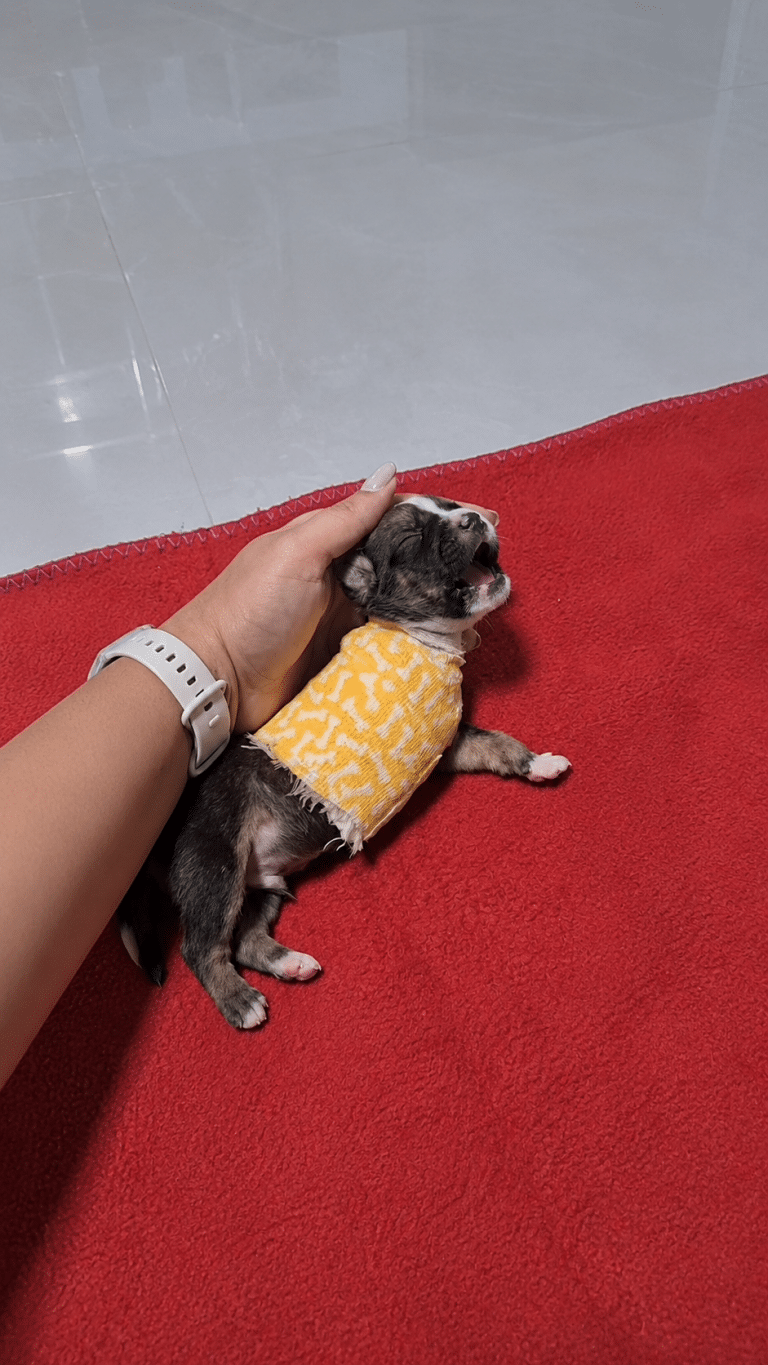
Happy was only ten days old when someone found him beside a pile of garbage.
He was so small that he could barely move.
At an age when most puppies are still sleeping beside their mothers, this little dog was facing something no newborn should ever experience.
One of his legs was severely injured.
His tiny body was weak.
And even crying seemed to require more strength than he had left.
There was no way for Happy to understand what had happened to him.
He could not walk away.
He could not search for food.
He could only lie there, waiting for someone to notice.
When rescuers finally found him, they knew his condition was serious.
They carefully lifted the fragile puppy and rushed him to veterinary care.
But the examination brought heartbreaking news.
His injured leg could not be saved.
Happy was about to lose part of a limb before he had even learned how to walk.
And nobody knew whether his tiny body would be strong enough to survive what came next.
A Ten-Day-Old Puppy Was Fighting for His Life
Happy should have been spending his earliest days somewhere warm.
At ten days old, a puppy is almost entirely dependent on others.
He needs frequent milk feedings.
He needs help staying warm.
And he needs protection while his body slowly develops the strength to explore the world.
Instead, Happy had been found near discarded garbage with a devastating injury.
When veterinarians examined him, they quickly understood how limited their options were.
The damage to his leg was too severe for ordinary treatment to repair.
Leaving the injured portion in place could place the newborn at even greater risk.
The veterinary team made the difficult decision to remove it.
For a puppy so young, surgery was especially challenging.
His body was tiny.
His physical reserves were limited.
And even after a successful operation, he would need intensive care.
But there was still a chance to save him.
The doctors proceeded with the treatment they believed was necessary.
Happy survived the procedure.
Now his caregivers faced another challenge.
Keeping him alive through the fragile days that followed.
Video: Rescuers Find a Ten-Day-Old Puppy With a Severely Injured Leg — His Fight to Survive Begins
Every Two Hours, Someone Was There With a Bottle
After surgery, Happy could not simply return to normal puppy life.
He was too young to eat independently.
His body needed nourishment, warmth, and constant observation.
So his caregivers established a demanding routine.
Every two hours, Happy needed milk from a bottle.
During the day.
Late at night.
And in the early morning hours when the rest of the world was asleep.
Someone had to prepare his feeding.
Hold him gently.
Make sure he received the nourishment he needed.
Then settle him back somewhere warm and comfortable.
His surgical area also required attention.
Caregivers cleaned and monitored the healing site while administering prescribed medication.
Every change in his condition mattered.
Was he drinking enough?
Was his body temperature stable?
Was he becoming more responsive?
For such a young puppy, even a small setback could be serious.
Happy had survived surgery, but recovery was far from guaranteed.
The people caring for him knew that their work was only beginning.
Some Nights, His Tiny Cries Were All They Heard
The first days were difficult.
Happy developed fevers.
There were nights when he cried despite the warmth and attention surrounding him.
His caregivers could not always know exactly what was making him uncomfortable.
They only knew that his body had endured an enormous amount in a very short life.
He needed rest.
He needed continued medical care.
And he needed people willing to remain patient while he recovered.
So they stayed close.
They continued the scheduled bottle feedings.
They monitored his temperature.
They kept his bedding clean.
And they watched the surgical area for signs of healing.
At first, progress was difficult to recognize.
Happy remained fragile.
His movements were limited.
Much of his day was spent resting.
Then something encouraging happened.
He began drinking milk more eagerly.
The change was small.
But for a puppy who had struggled to take in nourishment, it mattered.
Over time, his weight began increasing.
His responses became stronger.
And one day, his caregivers noticed something that made them smile.
His tiny tail moved.
Just a brief wag.
But it was another sign that Happy was beginning to feel stronger.
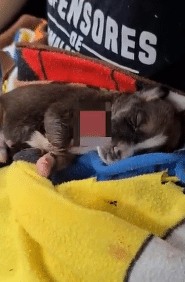
The Puppy Who Nearly Didn’t Survive Began Discovering the World
As the weeks passed, Happy’s life gradually became less focused on emergency treatment.
His body continued healing.
He grew.
And the world around him began offering new experiences.
There were warm baths.
Soft blankets.
Toys placed nearby for him to investigate.
And familiar people who had become part of his everyday routine.
Happy began showing the curiosity expected from a growing puppy.
He explored what was around him.
He mouthed toys.
He responded to gentle attention.
And he became increasingly interested in moving toward the people he recognized.
His earliest days had been filled with pain and medical care.
Now he was beginning to experience something different.
Ordinary puppyhood.
He could eat.
Sleep.
Play.
And discover new things.
But Happy was approaching a milestone that would present another challenge.
He was finally becoming old enough to learn how to stand.
And unlike most puppies, he would have to figure it out with only three legs.
Video: After Surviving Surgery and Weeks of Bottle Feeding, Happy Begins His First Attempts to Stand
His First Steps Were Unsteady, but He Kept Trying
When Happy first attempted to stand, balance was difficult.
His small body had to distribute its weight differently.
Without four legs beneath him, movements that came naturally to many puppies required adjustment.
He pushed himself upward.
Wobbled.
Then lowered himself back down.
Sometimes he leaned to one side.
Other times, a movement that seemed promising ended with him sitting unexpectedly.
But Happy continued trying.
His caregivers stayed nearby to keep him safe while allowing him opportunities to practice.
They did not expect perfect movement.
They understood that he needed time to learn what his body could do.
One attempt followed another.
A few seconds upright.
Then a rest.
Another effort.
Then a small movement forward.
Gradually, Happy began finding his balance.
He learned how to shift his weight across his remaining legs.
And eventually, those uncertain movements became his first steps.
The puppy who had once been too weak to move was beginning to explore on his own.
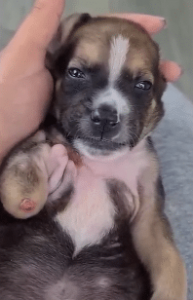
Soon, Three Legs Were Enough for Playtime
Happy’s progress continued.
At first, he moved with short, uneven hops.
Turning too quickly sometimes made him lose his balance.
Crossing a room could require several pauses.
But he was learning.
His muscles became stronger.
His coordination improved.
And before long, Happy was moving toward people whenever he wanted attention.
He followed familiar caregivers.
Chased toys.
Explored the room.
And climbed toward anyone sitting close enough to offer a comfortable lap.
The tiny puppy who had once needed help with almost everything was becoming increasingly independent.
His missing leg remained part of his life.
But it did not prevent him from being playful.
He still wanted to investigate unfamiliar objects.
He still wanted affection.
And he still seemed determined to reach whatever had caught his attention.
His caregivers watched as the weak newborn developed into an active young dog.
Yet the veterinarians had also been considering another possibility for his future.
One that might offer Happy additional support as he continued growing.
Doctors Had Preserved the Possibility of a Prosthetic Leg
During Happy’s early treatment, veterinarians had preserved part of the affected limb.
That decision left open the possibility that he could eventually use a prosthetic.
It was not a guarantee.
And it did not mean Happy could not enjoy life on three legs.
By this point, he had already shown that he could stand, move around, and play.
But an appropriately fitted prosthetic might provide additional support as he grew.
It could potentially help distribute pressure more evenly across his body.
When a custom device was eventually prepared, Happy faced another unfamiliar experience.
He had already learned to balance without the missing part of his leg.
Now he would need to adjust again.
The prosthetic would change the way his body made contact with the ground.
It would introduce a new feeling.
And he would have to learn how to use it.
His caregivers understood that simply attaching the device would not be enough.
Happy needed practice.
Encouragement.
And the freedom to move at his own pace.
Fortunately, those were things he already knew well.
His First Steps With the Prosthetic Made Everyone Smile
When Happy first wore the prosthetic, he seemed uncertain.
He looked toward the unfamiliar attachment.
Shifted his body.
And appeared unsure of how to include it in his movements.
His caregivers encouraged him gently.
They used calm voices.
Offered treats.
And allowed him time to become familiar with the new sensation.
Then Happy took a cautious step.
His body wobbled.
He adjusted his balance.
And tried again.
At first, he seemed reluctant to place weight through the prosthetic.
But with practice, he gradually began allowing it to touch the ground.
One step followed another.
The movement was still unsteady.
But Happy was learning.
Just as he had when first standing on three legs, he needed repetition.
There were pauses.
Awkward attempts.
And small improvements.
Then his confidence began growing.
The prosthetic became less unfamiliar.
His steps became more coordinated.
And before long, Happy was moving with the enthusiasm that had become part of his personality.
He had learned to walk once after losing a leg.
Now he was learning again with additional support.
By Christmas, Happy Was Almost Unrecognizable
Months after his rescue, Happy looked nothing like the tiny puppy found beside the garbage.
He had grown.
His body was stronger.
His movements were more confident.
And his days were filled with activities that once seemed impossibly far away.
He played with toys.
Followed his caregivers.
Explored his surroundings.
And settled comfortably into their arms when he was ready to rest.
By Christmas, the transformation was remarkable.
The fragile newborn who once required a bottle every two hours had become an energetic young dog.
He could move around independently.
He enjoyed attention.
And he had adjusted to using a prosthetic.
But the device was only one part of his recovery.
Happy had reached this point because people continued caring for him long after the emergency surgery was finished.
Someone had remained awake for nighttime feedings.
Someone had monitored his fever.
Someone had cleaned his bedding.
Someone had encouraged him through his earliest attempts to stand.
And someone had stayed beside him while he learned to use the prosthetic.
Those ordinary acts had gradually built the life he now enjoyed.
He Lost a Leg Before Learning to Walk — But He Never Lost His Chance at a Happy Life
Happy’s story began when he was only ten days old.
He was found near a pile of garbage with a leg so badly injured that part of it could not be saved.
His body was fragile.
His future was uncertain.
And even surviving the surgery was only the beginning.
The weeks that followed required constant care.
Bottle feedings every two hours.
Medication.
Warmth.
Close observation.
And patience through the moments when his recovery seemed painfully slow.
But gradually, Happy became stronger.
He began drinking more.
He gained weight.
His tiny tail wagged.
He discovered toys.
Then he began trying to stand.
At first, he stumbled.
Later, he could move confidently on three legs.
Eventually, he learned to use a prosthetic too.
Each stage brought new challenges.
And each stage gave him another opportunity to discover what his growing body could accomplish.
By Christmas, the puppy once barely able to move had become playful, affectionate, and full of energy.
His missing leg remained part of his story.
But it no longer overshadowed everything else.
Happy could explore.
Play.
Seek comfort from familiar people.
And enjoy the ordinary experiences of a young dog surrounded by care.
He had lost part of a leg before taking his first steps.
Yet he was given something far more important than a perfect beginning.
People who stayed.
People who helped him heal.
And people who celebrated every small improvement until those uncertain first steps became a life filled with movement.
Happy could not change what happened during his earliest days.
But the care he received changed what came afterward.
And the little puppy once found beside the garbage finally had the chance to grow into his name.