From the street, the rooftop was easy to overlook. Up there, a dog named Soñador had spent a decade or more in a place he could not leave on his own.
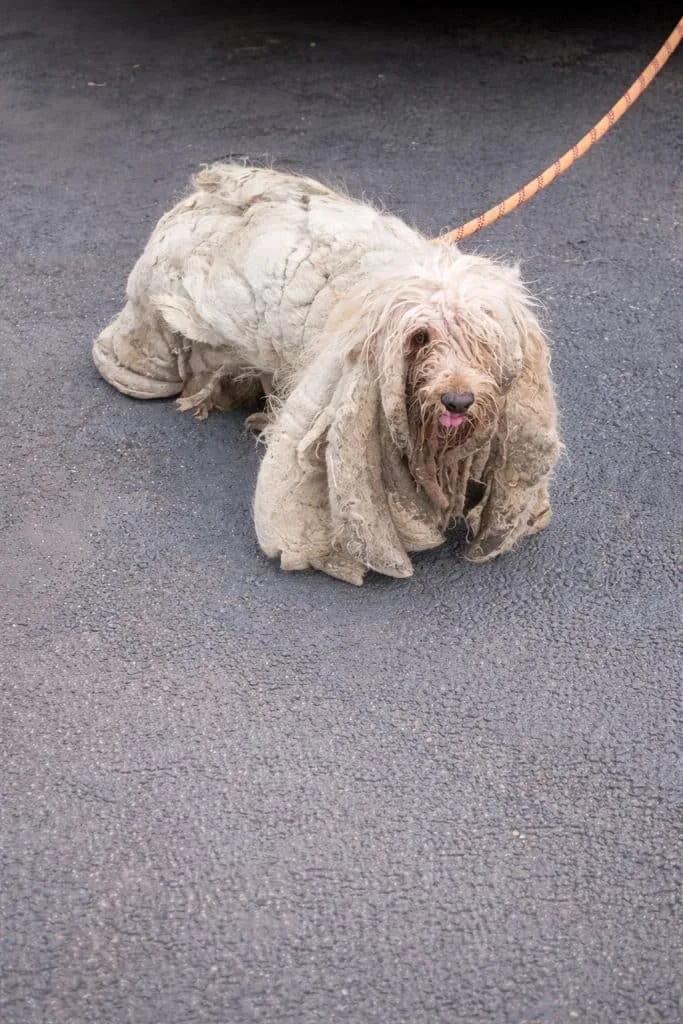
Concerns about him had reportedly been raised more than once. Even so, nothing changed until help finally arrived. By then, rescuers could hardly tell where his body ended and the thick mass of fur around it began.
His coat had grown so heavy that standing was a struggle. He was weak, and he had lost his hearing. What the team did next would show how much of Soñador had been hidden all along.
A Dog Above the Street, Out of Sight for Years
Year after year, Soñador was exposed to the weather. According to the account of his rescue, he had no proper shelter from intense heat, cold nights, or heavy rain. No companion rested beside him, and no familiar person appeared each day to look after him.
There was only the rooftop.
His coat kept growing without proper care. Loose fur twisted together with dirt and moisture and formed dense mats that covered nearly every part of his body. The weight pulled against his skin and restricted his legs. Even changing position wore him out.
When rescuers reached him, they had trouble telling the dog from the fur surrounding him. He was dangerously weak and dehydrated. Infections affected his mouth and skin, and the team learned that he could no longer hear.
He could not hear the gentle voices around him. He could, however, feel the careful hands reaching toward him.
Video: Soñador Is Freed From the Heavy Coat After Years on a Rooftop
Too Weak to Walk Away, He Was Carried
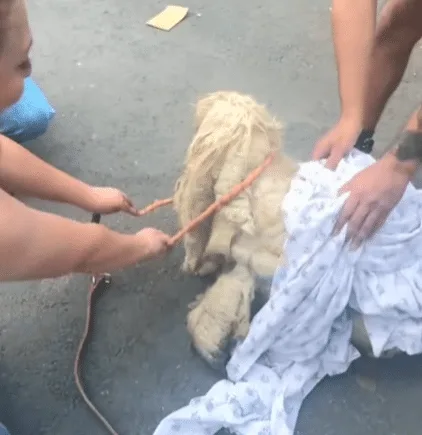
It became clear almost immediately that Soñador could not walk off the rooftop by himself. The coat that surrounded him had turned into both a burden and a trap. His muscles were weak, his body was exhausted, and each movement demanded more strength than he had left.
So the team brought a blanket and wrapped it around him. They supported his fragile frame with care, making sure the heavy mats did not tug painfully at his skin as he was lifted.
Because he was deaf, soothing words could not reach him. He had only the strangers’ actions to go by, and those actions were unhurried. Nobody rushed him or handled him roughly. Every movement was slow and deliberate.
After a decade or more, Soñador was carried away from the place that had made up his entire world. He appeared frightened and uncertain, but he was no longer alone.
At the Clinic, the Coat Had to Come Off in Pieces
At the clinic, veterinary and grooming teams began the difficult work of removing the coat. This was nothing like an ordinary haircut.
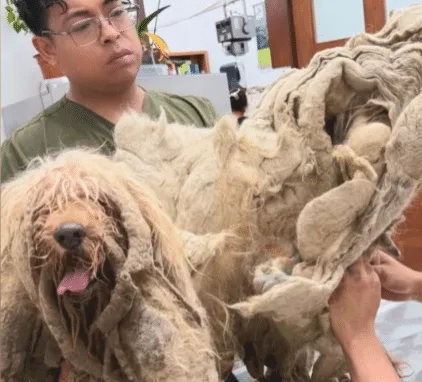
The fur had hardened into thick, compacted layers pressed close against sensitive skin. Dirt and moisture had been trapped beneath it for years, which created the conditions for irritation and infection. The mats could not be pulled loose or brushed out. They had to be separated and cut away one section at a time.
The team worked patiently, and whenever Soñador seemed uncomfortable, they paused. One section came away, then another. Gradually the outline of his body began to appear. His legs came into view, and then his face.
More Than 12 Kilograms of Fur, and a Much Smaller Dog
Once the clipping was finished, the removed fur was weighed. It came to more than 12 kilograms.
Beneath it was a dog far smaller and more fragile than anyone could have guessed from the shape on the rooftop. Every time Soñador had tried to stand, turn, or lie down, he had been moving that weight along with his own body.
Now it was gone. The relief must have been immediate, but the rescuers knew the work was far from over. What remained was a weak body that would need time, treatment, and steady care.
What the Weight Had Been Covering
With the mats gone, the toll of years without proper care was easier to see. His skin was irritated and infected. His mouth needed treatment. His body needed fluids, nourishment, and rest.
Taking off the coat eased his burden, but it could not give back years of lost strength overnight. So recovery began quietly, with ordinary tasks done consistently.
Caregivers cleaned and treated his skin. They offered carefully prepared meals. They gave him a soft, protected place to sleep, away from the rain, the cold, and the hard surface of the roof.
There was no single dramatic turning point. Progress came through repetition, as his basic needs were met again and again.
Learning Trust With a Dog Who Cannot Hear
Soñador’s deafness shaped how the people around him behaved. Sudden contact could startle him, so caregivers let him see or feel their presence before they touched him.
Over time, their routines became a kind of language. A bowl set gently in front of him meant food was coming. A familiar hand against his side meant treatment. A clean bed meant he could rest.
The account does not describe what Soñador understood or felt. What it does describe is a pattern that stayed the same from one day to the next. Care arrived the way it had the day before, and gradually he had the chance to learn what to expect from the people around him.
Short Steps That Grew Longer
As his body recovered, Soñador became more active. Without the heavy coat restricting his legs, he could move more freely. At first he managed only short, uncertain movements. Then he began walking farther.
His strength improved, and his curiosity returned. The exhausted dog who had barely responded on the rooftop started paying attention to the people nearby. He watched their movements and settled into familiar routines. He also began accepting gentle affection.
For a dog who had spent so long isolated above the streets, those small exchanges were significant. He was getting used to company and to regular meals. He was getting used to sleeping without rain or exposure interrupting him.
The Life He Has Now
Today, Soñador is no longer the forgotten shape on a rooftop. He can move without kilograms of hardened fur dragging at his body. He can rest in comfort and explore his surroundings.
The change is striking, but it is not only a matter of how much fur was removed or how far he can walk. It shows in how he relaxes around the people caring for him and in how readily he accepts their presence.
The account does not say where Soñador will live over the long term, and nothing can return the decade he spent up there. What it does make clear is that his days no longer have to look like the ones before.
His story also carries a plain reminder. Noticing that an animal is suffering is not enough, because concern has to turn into action. An animal weakened by isolation and neglect cannot always reach safety alone.
More than 12 kilograms were cut away from Soñador. With them went the weight that had kept him pinned to the rooftop, waiting for someone to carry him back into the world.